Manufacture High-Performance Flexible Components with Production-Grade Consistency
Elastomeric components sit at the core of modern product design across wearables, medical devices, industrial systems, transportation, consumer goods, and performance engineering. These parts must combine flexibility, energy return, tear resistance, and long-term durability while maintaining dimensional accuracy and repeatable manufacturing performance.
Traditional elastomer manufacturing relies heavily on injection molding with complex tooling, long lead times, and limited design flexibility. Prototyping often uses non-representative materials that fail to reflect final product behavior, creating gaps between design intent and production reality.
Axtra Solutions for Elastomer Applications removes this gap by combining the Lumia X1 powered by Hi-Speed SLA (HPS), validated elastomeric materials, and production-optimized workflows into a single manufacturing system. This enables manufacturers to produce functional elastomer components that behave like final production parts, without the cost or delay of tooling.
The Manufacturing Challenge
Elastomer components are uniquely difficult to manufacture.
Unlike rigid materials, elastomers must maintain performance under repeated deformation while resisting tearing, fatigue, and permanent set. Achieving this balance typically requires tightly controlled molding processes and carefully tuned material systems.
Conventional manufacturing introduces several constraints:
For industries such as medical devices, footwear, automotive interiors, robotics, and consumer products, these limitations slow innovation and increase development risk.
The Axtra Solution
Axtra Solutions for Elastomer Applications provides a validated digital manufacturing workflow designed specifically for flexible, functional elastomer parts.
The complete solution integrates:
This system enables manufacturers to produce elastomer parts directly from CAD data with production-relevant mechanical behavior, enabling true functional testing before committing to tooling.
It supports both rapid prototyping and low-volume production of flexible components with consistent performance across builds.
Customer Value
Achieve True Functional Elastomer Behavior
Move beyond “soft prototypes” into real elastomeric performance.
Parts exhibit reliable flexibility, rebound, and energy return suitable for functional validation and end-use applications.
Accelerate Product Development
Eliminate long tooling cycles for flexible components.
Design iterations can be manufactured within hours, enabling rapid refinement of fit, comfort, and mechanical response.
Reduce Dependency on Prototype Materials
Many conventional prototyping methods fail to replicate true elastomer properties.
Axtra Solutions uses qualified materials that closely represent production behavior, improving validation accuracy.
Enable Complex Flexible Geometries
Manufacture designs that are difficult or impossible to mold conventionally, including:
Lower Cost for Low-Volume Elastomer Parts
Elastomer tooling is expensive and often unjustified for early-stage or niche products.
Digital manufacturing enables economically viable production without molds.
Improve Design Freedom
Engineers are no longer constrained by draft angles, parting lines, or tooling limitations.
Flexible design can be optimized for performance rather than manufacturability constraints.
Why Hi-Speed SLA Makes the Difference
Elastomer printing requires precise control over cure dynamics, layer uniformity, and material stability to avoid over-curing, brittleness, or loss of elasticity.
Hi-Speed SLA (HPS) enables this balance by combining laser precision with DLP throughput, ensuring consistent mechanical performance across flexible materials.
Consistent Elastic Performance
Controlled curing ensures elastomer parts maintain predictable Shore hardness and elongation characteristics across builds.
High-Fidelity Geometry Reproduction
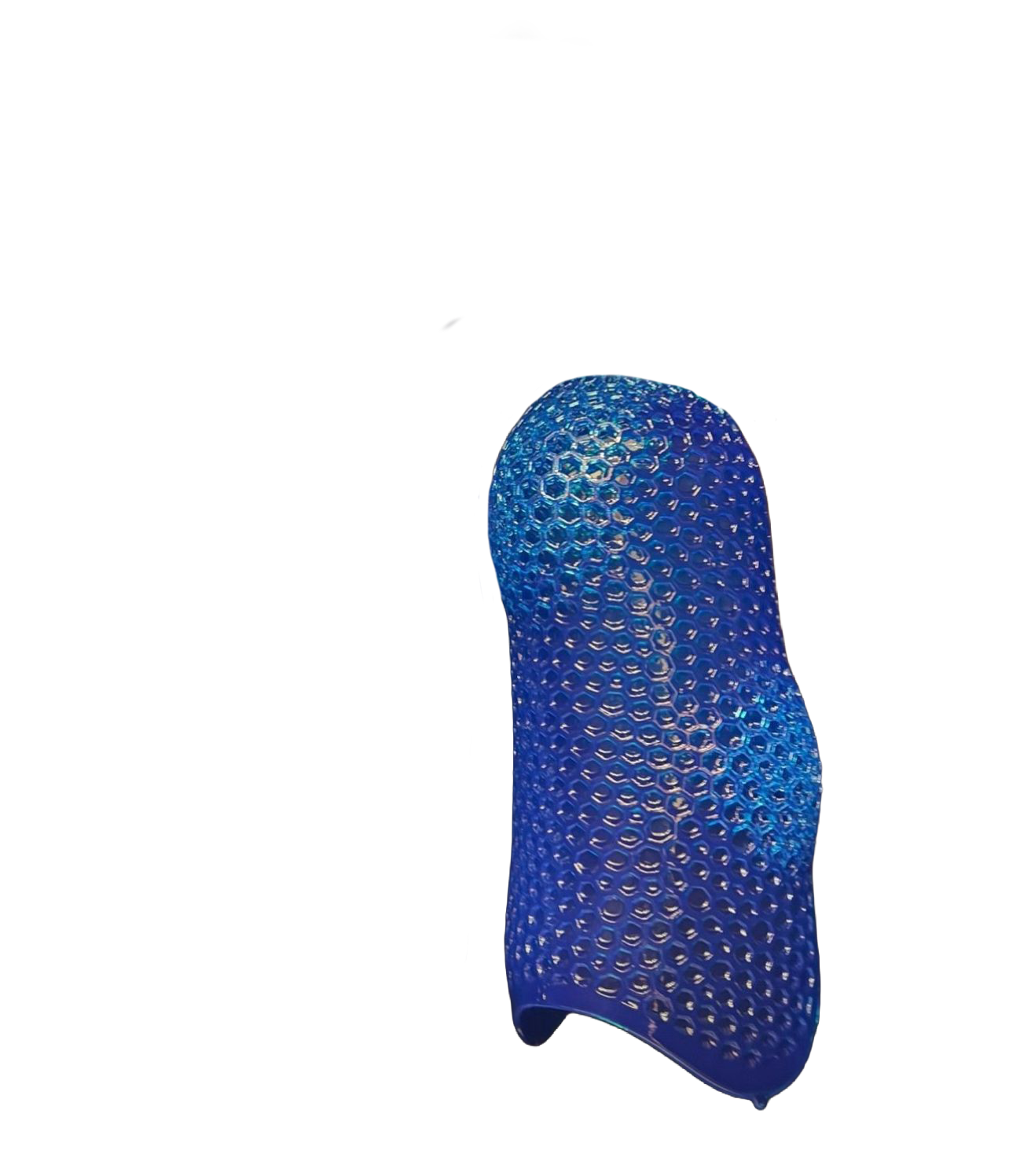
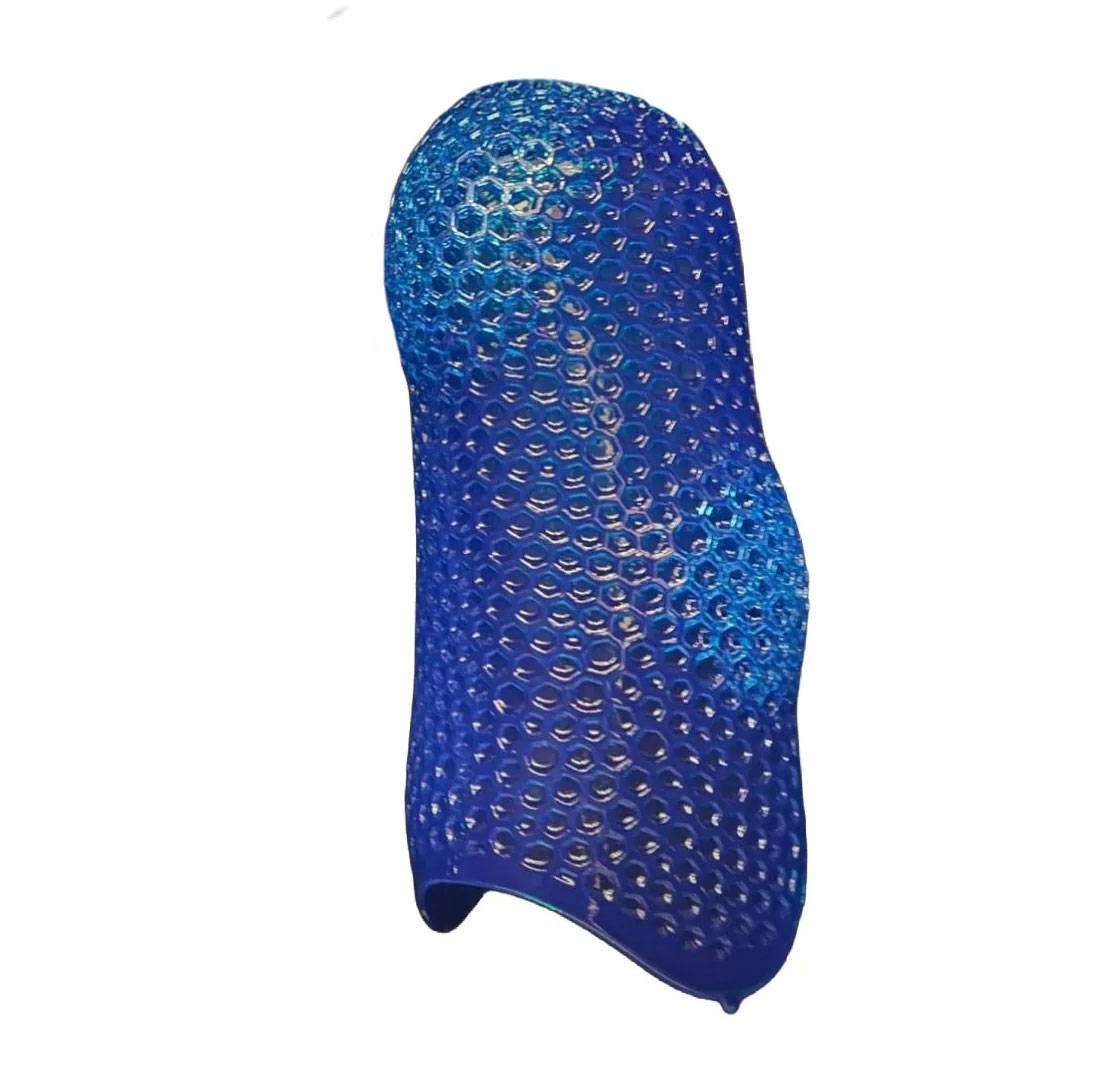
Fine lattice structures, thin walls, and complex flexible geometries are accurately reproduced without distortion.
Smooth Surface Finish
Surface quality directly impacts tactile performance in elastomer applications such as wearables, seals, and consumer products.
HPS minimizes surface artifacts for improved functional and cosmetic performance.
Reliable Repeatability
Validated process parameters ensure consistent elastomer behavior across production runs, enabling dependable functional validation and end-use manufacturing.
High Productivity for Flexible Parts
Multiple elastomer components can be produced simultaneously without compromising material performance or accuracy.
Qualified Materials
Axtra Solutions for Elastomer Applications is built around three validated elastomeric resins, each optimized for different performance, regulatory, and application requirements.
LOCTITE® 3D IND475
A high-performance industrial elastomer designed for durability, resilience, and snap-back performance.
Material Characteristics
Typical Applications
IND475 is optimized for industrial environments where durability and mechanical resilience are critical.
LOCTITE® 3D MED414
A medical-grade elastomer designed for regulated healthcare applications requiring safety, consistency, and biocompatible performance.
Material Characteristics
Typical Applications
MED414 is designed for applications where performance consistency and regulatory compliance are essential.
Forward AM Ultracur3D® EL 4000
A high-performance elastomer engineered for demanding mechanical applications requiring higher stiffness and structural integrity while maintaining flexibility.
Material Characteristics
Typical Applications
EL 4000 bridges the gap between soft elastomers and structural polymers, enabling engineered flexibility in load-bearing applications.
Typical Applications
Axtra Solutions for Elastomer Applications supports a broad range of industries:
Performance Highlights
Why Axtra Solutions
Axtra Solutions for Elastomer Applications integrates the Lumia X1, Hi-Speed SLA technology, LOCTITE® 3D IND475, LOCTITE® 3D MED414, and Ultracur3D® EL 4000, along with validated process parameters and Axtra.Workflow into a unified manufacturing system.
This enables manufacturers to move beyond prototyping elastomers into true production-relevant flexible manufacturing. The result is faster iteration cycles, lower tooling dependency, improved functional validation, and reliable production of elastomer components that meet the mechanical and regulatory demands of modern industries.